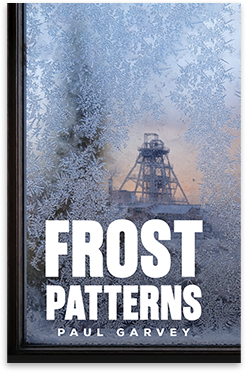
'Frost patterns': the setting and my ‘coalfield Yorkshire’ dialect.
The West Riding of Yorkshire, where 'Frost Patterns' is set has dialects are very specific to small areas. The way people spoke - and the older people still speak - changed across small distances and the changes were very recognisable to the inhabitants of those areas. I lived in Pontefract as a child and I’ve modelled the accent on what I heard and spoke, though my own accent (which is still there!) and my family’s accents, were not quite as broad as the local ex-miners’ accents who worked at the Prince of Wales colliery.
Normanfield is not based on an individual town; neither is Moorton Tops a real village. They are more pastiches from towns and villages in the Pontefract and Castleford area. However, Pontefract is real. Pontefract, Castleford and Normanton are at the three corners of a 6x5x3 triangle. If you’d gone to Normanton, only 6 miles distant to Pontefract, as late as 1970, you’d have heard the word ‘cock’ used as a word for a younger lad, as in the very common greeting; ‘oraigh’ cock?’ Cock was used less often in Castleford, 5 miles from Normanton and even less often in Pontefract - though it was always used in all three areas, in a different context, to describe the best fighter in the school - the ‘cock of the school’ (as was Walter Middleton, ‘cock of the infants’).
The accents of these towns were different and if you lived in Pontefract all your life, you’d know someone who’d spent a life in Castleford (only 3 miles distant, beyond the racecourse past the coke ovens and on past Glasshoughton colliery, which are all mentioned in the book) with the way they spoke. One side of my family lived for most of their lives in Ferry Fryston, a quite isolated council estate, just a short bus ride from the centre of Castleford. My Grandparents, uncles, aunties and cousins who lived there were not miners (others on the Pontefract side of my family were), though many of their neighbours worked in Fryston Colliery. However, their accents were distinct to me and I could even distinguish their accents from those of people living down the hill in Castleford! Even the use of the dialect by individuals in the same area could be different. Upbringing, though similar, was not the same and different families’ use and pronunciation of some dialect terms was different to that of others in the same street.
I believe that this particular local accent deserves a book of its own, by a specialist linguist, before it dies out. There are generic books about the West Riding dialects and Wikipedia is a good starting place if you wish to learn more, with lots of links to more academic studies, but there’s nothing that I have found, specific to this area.
There’s more detailed notes about the dialect - which I’ve termed ‘Coalfield Yorkshire’ and is spoken by all the mining families in the book - and also how I have expressed it in sentence construction. I’ve spelled ‘coalfield Yorkshire’ words almost exactly as I heard them, except for two. I drew a line at spelling the everyday word ‘come’ as ‘cum’ and I couldn’t bring myself to spell couldn’t, as ‘cun’t; sorry!! ‘Frost Patterns’ contains my linguistic memories and comments, but please don’t think my book notes are a research thesis!
Here’s a flavour:
‘The’ is normally totally absent before a subsequent noun. In ‘Coalfield Yorkshire’ ‘the’ is not shortened, it is aspirated. It is not said, as in the typical caricature of Yorkshire dialect. Thus; ‘we’re off dahn ‘pub for a pint’. Not; ‘we’re off dahn t’pub for a pint’. Sometimes ‘The’ might be pronounced for effect, or in stock phrases like; ‘Wot the ’ell’s ‘ee doin’?’, but you could go long conversations without hearing the word ‘the’ at all. The missing ‘t’ causes some problems when it is at the end of a word, especially a short one like get. For instance; ‘get sum milk, luv’, becomes; ‘ge’ sum milk, luv.
Post Views : 4